Friday, September 27, 2013

real comptrollers would tell Nassau


residents how much Teresa Butler and her attorney were paid when she sued after being fired for not ringing the door bells for Tom Suozzi.


Weitzman won't withdraw SEC complaint against Maragos

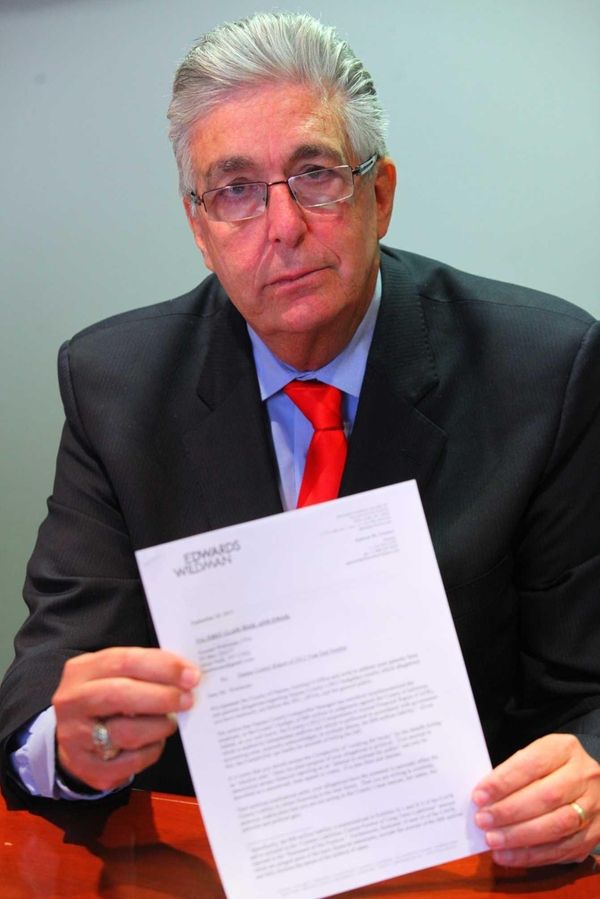
Former Nassau County Comptroller Howard Weitzman speaks in
Photo credit: Howard Schnapp | Former Nassau County Comptroller Howard Weitzman speaks in Garden City about a letter he received from the current county Comptroller Geroge Maragos. (Sept. 26, 2013)
Former Nassau Comptroller Howard Weitzman on Thursday rejected a county-hired lawyer's demand to stop criticizing his successor, George Maragos, and to withdraw a complaint with the U.S. Securities and Exchange Commission against Maragos and the county.
"I have every right to file such a complaint as a private citizen and will not withdraw it," Weitzman said at a news conference at the Garden City office of his lawyer, Steven Schlesinger.
Weitzman, a Democrat, is challenging Republican Maragos for the job in November.

STAY UPDATED: News alerts, newsletters | Twitter | Facebook

Last week, Weitzman announced that he had asked the SEC to look at how "Maragos and the administration manipulated county finances to claim that the county ended the year with a 'miraculous' surplus."
He called it a "new low" for Maragos to get a lawyer with taxpayer dollars to threaten his political opposition.
Earlier this week, Andrew Grumet, a Manhattan securities lawyer hired by Nassau County, demanded that Weitzman pull back his SEC complaint and make a formal and public retraction of his "libelous and slanderous allegations."
Nassau County Attorney John Ciampoli, who hired Grumet, on Thursday said Weitzman got a failing grade from the public four years ago and now is trying to burn down the house he claims he still wants to serve. "His allegations, while patently false, could harm Nassau financially. We want him to stop his distortions," he said.
The biggest issue in Weitzman's complaint was $88 million in 2012 property tax refunds that Ciampoli got the courts to shift to 2013. That was done, Weitzman said, solely to make the county and the administration look good with a financial surplus for the year.
"No," Ciampoli said. "I knew the county would benefit on the books. But I requested it because forcing the county to pay it immediately would have created all kinds of negative consequences for Nassau and its residents. It was that simple.
"We will be conferring with our outside counsel on what the appropriate next step is. We are not bluffing."

What are the views, if any, of Jillian and

Elisabeth Given regarding the work of Dr. Denise L Faustman, see faustmanlab.org, and pubmed.org fasutman dl and BCG and its utility in treating and/or curing autoimmune diseases?

Jillian Given, 5, dials 911 to save diabetic mom

Jillian Given, 5, of Ronkonkoma, is being credited with saving her mom's life after she called 911 when Elisabeth Given, who has Type 1 diabetes, had become unresponsive.
Five-year-old Jillian Given wasn't rattled.
In what authorities describe as "calm and collected" fashion, the Ronkonkoma girl made a 911 call last week that officials say saved her mother's life.
"My mom is diabetic and she is in a room and, um, . . . my mom is like passed out," she says during the 5-minute, 15-second emergency call that came in about 6:30 a.m. on Sept. 16.
"I'm 5 years old, and I tried to call my daddy, but it didn't work," she says.
Following the dispatcher's directions, Jillian says her mother is breathing, but not awake.
In the next five minutes, she struggles with locked doors, but manages to let out three golden retrievers and let in the police.
"She's a very brave young girl," said John Martins, assistant chief of the Nesconset Fire Department, who aided the duo. "I've never been on a scene with a 5-year-old that was as well-versed and as calm as she was. Most adults haven't been that cool, calm and collected."
Jillian, along with her mother, Elisabeth Given, and family gathered Wednesday at the Nesconset firehouse and thanked officials who responded to the child's call.
Elisabeth Given, who has the more severe type 1 diabetes, teared up Wednesday about what might have happened had Jillian not made the call. "I would have not been here. . . . She's my hero," Given said. "I think about it every day, and I cry every day. I can't believe she did it. . . . She saved my life."
Given, a registered nurse and diabetes educator, said she had coached Jillian in recent months on emergencies. "I basically just said, 'If you're home with Mommy by yourself and she never can answer or talk to you, you have to call 911,' " Given said.
The mother and daughter were housesitting for Given's parents in Nesconset when she fell ill, Given said. Jillian said she tried to talk with her mother, but became nervous when Given didn't wake up.
Martins said authorities found Given on a bedroom floor. Rescuers gave her glucose intravenously, he said.
Matt O'Reilly, an emergency medical technician at the scene, said knowing Given was a diabetic was critical. "If [Jillian] did not call 911 at that time, by the time somebody found her, she probably would have been in cardiac arrest," he said.
Given said she went to Stony Brook University Hospital about an hour after the glucose was administered and learned she had hit her head when she fell from the bed. The wound required a few staples.Elisabeth's mother, Pam Siebel, said she thanked Jillian for her fast action, to which Jillian responded, "I didn't want my mommy to die," Siebel said. "She knew the potential that was there. . . . I'm so proud of her."
Though family members and authorities have touted Jillian's quick thinking, Given said her daughter has remained humble. "She says she's not a hero," said Given. "She's just Jillian."Jillian will receive an award Friday at her school, Cherokee Street Elementary School in Ronkonkoma, which she said makes her feel "good."

Wednesday, September 25, 2013

Iranian President announces he will supply

Americans with BCG, something that the US does not do for all its citizens to achieve good health.
Even Persians can read and readily understand the work of Dr Denise L Faustman, faustmanlab.org and pubmed.org faustman dl. Perhaps Iran may influence Americans by providing what is available all over the world except here?


Firms Drop, Rather Than Upgrade, Cheapest Health Plans

Big Security-Guard Provider Will Steer 55,000 Workers to Exchanges

    By
  • SCOTT THURM
The nation's largest provider of security guards plans to discontinue its lowest-cost health plans and steer roughly 55,000 workers to new government-sponsored insurance exchanges for coverage next year, in the latest sign of the fraying ties between employment and health care.
Bloomberg
Customer Mildred Gooden, right, looks at washing machines with employee Meti Robi at a Home Depot store last year.
The U.S. arm of Sweden's Securitas AB SECU-B.SK -0.47% is among more than 1,200 employers that offer the kind of bare-bones health plans that must be phased out beginning Jan. 1 under the health-care law. Nearly four million people are enrolled in these so-called mini-med plans, which cap benefits to participants, sometimes at as little as $3,000 a year.
"The mini-meds go away and we're not replacing them," said Jim McNulty, a spokesman for Securitas's U.S. operation. "Their option is to go to the exchanges."
Other big employers, including Darden Restaurants Inc., DRI -0.90% Home Depot Inc. HD -0.68% and Trader Joe's Co., say they will stop offering health insurance to part-time workers, and will direct those employees to the state exchanges. Darden, Home Depot and Trader Joe's previously offered mini-meds to their part timers.
The breadth of the trend isn't clear, as employers scramble to finalize their 2014 health-care offerings. Analysts have long speculated that the launch of the insurance exchanges could prompt some employers to drop health coverage. But benefits consultants said they know of few companies now providing insurance that won't offer it to full-time workers next year.
In July the Obama administration may have inadvertently opened a window for some companies to drop coverage by imposing a yearlong delay on penalties for employers that don't offer health insurance.
Until then, Securitas executives said, they had planned to offer guards a health plan with more benefits, but which would have required employees to pay more to participate. Executives subsequently changed course, deciding not to offer insurance to most guards next year, and to develop offerings that comply with the health law for 2015.

Related Video

Enroll America, a nonprofit organization, is canvassing and doing other types of outreach in New Jersey to get the word out about the Affordable Care Act.
Experts disagreed on how an influx of working Americans would affect the exchanges. Dave Axene, a consulting actuary and fellow of the Society of Actuaries, said working people tend to be relatively healthy, and might improve the economics of the exchanges. He questioned how many would enroll, however.
But Ron Fontanetta, a senior health-care practice leader at consulting firm Towers Watson, TW +0.12% said the workers most likely to tap the exchanges are those who need the most medical care, potentially forcing insurers to pay out more than projected for claims. "The individuals that have the most urgency to enroll will be those that have health conditions," he said.
Mini-meds are most common in low-wage industries such as retailing, restaurants and agriculture. They are relatively cheap, with premiums around $100 a month or less, depending on their scope.
They typically require small, if any, co-pays and deductibles. Some employers pick up the entire cost, and don't require any employee contributions, which is rare for other types of health insurance.
The flip side is that the benefits are limited, so policy holders suffering serious accidents or illness can face big medical bills. That troubled architects of the health law, which prohibits annual benefit caps.

The Health Law Rollout

Explore how America's health-care overhaul will affect you on this first-person adventure. CLICK THE IMAGE to start interactive experience.
Jonathan Gruber, one of the law's authors, and an economics professor at the Massachusetts Institute of Technology, said mini-meds weren't truly insurance. "If you have insurance that taps out and doesn't protect you against risk, it isn't really insurance," he said.
Employers who offer mini-meds say they are valuable to low-wage workers. They say the prohibition is forcing them to offer better, but more expensive, plans to people who may not be able to afford them or take advantage of them. To reduce costs, many of the new plans require large deductibles before the insurance kicks in.
At Rancho Guadalupe LLC, which grows fruits and vegetables on 4,000 acres near Santa Maria, Calif., roughly half of the 80 to 100 year-round workers now participate in a mini-med that costs workers $50 a month, according to general manager A.J. Cisney.
The plan requires $15 co-pays for a doctor visit and limits benefits to $25,000 a year.
On Jan. 1, the farm will switch to an insurance plan that, except for preventive care and some diagnostic tests, won't kick in until a worker has incurred $6,350 in medical bills. Mr. Cisney said he fears that workers won't see any value and won't enroll. "I'm really concerned what participation is going to look like when we talk to people about this deductible," he said."That's not what we want. We want our people covered."
Marek Family of Cos., a Houston-based home builder, began offering a mini-med about eight years ago, after executives saw that few hourly workers were enrolled in the company's more traditional insurance, said Larry Williams, director of human resources. Marek pays the full premium cost for its plan, which limits an employee's benefits to $60,000 a year.
"Employees loved that plan, that's what they wanted," Mr. Williams said. He said Marek is considering a plan like Guadalupe's with a relatively high deductible, as well as a plan offering limited benefits that complies with the law.
Mr. Williams expects those options to be more costly and said employees likely will have to contribute. Because of the timing of its renewal, Marek has until July 1 to come up with a replacement plan.
Erin Shields, a spokeswoman for the U.S. Department of Health and Human Services, said the law will improve the quality of health-care offerings and boost employer coverage in the long run. "Consumers will never again have to face bankruptcy when they get sick, because annual limits on coverage will be banned once and for all," she said.
Some workers whose employers don't offer them health insurance will be better off, because they will qualify for subsidies at the government-operated health exchanges that open Tuesday.
Workers aren't eligible for subsidies if their employer offers them comprehensive, affordable coverage.
The subsidies mean that many workers will find themselves better off financially if they their employer doesn't offer coverage, said Sheldon Blumling, a partner in the Irvine, Calif., office of Fisher & Phillips LLP who works on employee benefits,
Trader Joe's said more than 70% of its part-time workers would pay less to buy insurance through the exchanges than through the grocer's existing health plan. After the subsidies, the company said, many employees "should be able to obtain health-care coverage at very little, if any, net cost."
Securitas's 90,000 U.S. employees guard office buildings, hospitals, nuclear-power plants and public arenas such as Yankee Stadium, typically for wages of $10 to $25 an hour, according to Santiago Galaz, president of its North American unit.
About 12,000 employees were enrolled in the company's mini-meds, which cost them $100 a month for a plan with a $50,000 annual limit or $125 per month for a plan with $100,000 annual limit. Mr. McNulty said Securitas plans to tell employees about the change in the next month or two.
About 30% of Securitas's U.S. employees have insurance that complies with the health law, either because they are covered by a union contract or because the Securitas customer to whom they are assigned agreed to pay the additional cost.
Before the Obama administration delayed the employer penalties, Securitas executives had warned customers and investors to expect labor costs to rise 10% next year to cover additional health-insurance expenses.
When the administration delayed the penalties, executives reconsidered. "We're not about to pick up an additional cost we can't get reimbursed for," Mr. McNulty said. "We will try in 2014 to convince more of our customers to help share the burden of health care and expand coverage."
Write to Scott Thurm at scott.thurm@wsj.com
Dear Jason A Helgerson:

Please help see that BCG is available to all New Yorkers who seek same. see faustmanlab.org and pubmed.org faustman dl and simply talk to voting immigrants and world travelers who have come to the BCG wasteland that we call New York.


  • Office of Health Insurance Programs:  Corning Tower, Empire State Plaza, Albany, NY 12237
  •   518-474-3018 Deputy Commissioner, Office of Health Insurance Programs, NYS Medicaid Director Helgerson, Jason A


    Tuesday, September 24, 2013

    on the way to the Supreme Court?

    A federal court in Texas has rejected an argument by Churchill Downs Inc. that the state legislature’s ban on online gambling by Texas residents is a violation of the federal commerce clause of the U.S. Constitution.
    The decision scuttles an attempt by Churchill to continue to take bets from Texas residents through its market-leading account-wagering operation, twinspires.com. Churchill filed a lawsuit last September challenging the ban on online wagering, asserting that the ban violated the commerce clause because it treated bets at “bricks-and-mortar” sites differently than those placed through Internet account-wagering operations.
    Judge James R. Nowlin of the U.S. District Court for the Western District of Texas summarily rejected those arguments in an opinion issued Monday that dismissed Churchill’s suit with prejudice.
    “Their argument fails because it incorrectly treats brick-and-mortar gambling as identical to Internet gambling,” Nowlin wrote. “In fact, they are two wholly different activities.”
    Officials for Churchill did not immediately respond to requests for comment.
    Churchill’s suit was the first to be filed by an account-wagering operator seeking to overturn state bans on Internet wagering. It also was highly unusual in that it acknowledged that Texas law had long banned Internet wagering, but that the state only began enforcing the ban in 2011, an assertion disputed by members of the state racing commission and attorney general’s office.
    Nowlin wrote that states have the right to enforce different restrictions on betting depending on the means by which the bets are placed.
    “There may come a day when more sophisticated means for policing the Internet come into being, but until that day comes, this court will not interfere with the state legislature’s decision to treat online betting differently than gambling that takes place at brick-and-mortar establishments,” Nowlin wrote.

    and unlike Nassau OTB they are open for

    homosexual bettors every day of the year!

    Gotham

    Where Bettors Go to Lose, Some Doubts

    • Facebook
    • Twitter
    • Google+
    • Save
    • E-mail
    • Share
    • Print
    • Reprints
    I took a stroll through a glowing forest of slot machines — past a hospital aide who fed ragged dollars into them and a retired transit worker who peered into his empty wallet and a security guard who eyed me, wondering when I was going to sit down and start losing money.

    Connect With NYTMetro

    Metro Twitter Logo.
    Follow us on Twitter and like us on Facebook for news and conversation.

    Readers’ Comments

    It was early Monday morning, and I was inside the Resort World Casino at Aqueduct Racetrack, which looks like an airport departure lounge mated with a pinball machine. There were no smiles and no talk, and eye contact was reserved for the slot machine. Then I stepped outside and squinted into a sharp morning sun at Stu Litwin, an electrician. He was ambling toward the casino from the A train.
    What do you think, I asked him, of Gov. Andrew M. Cuomo’s plan to open up New York State to seven casinos like this? He shook his head, rueful.
    “It’s a losing deal, casinos,” he said. “I’ll be honest, I should have my head examined for coming here. You really don’t want the whole city doing this.”
    Our governor has developed a pronounced taste for gambling’s revenue streams. He has put a constitutional referendum on the ballot to allow full-fledged casinos, proposing to raise money for schools by letting the industry run its fingers through the pockets of working New Yorkers.
    The gambling industry now finds itself at El Dorado’s doorstep. And the governor tells us not to worry. He is righteous, and the industry will be carefully regulated.
    It’s intriguing to examine the effort to reform a related gambling enterprise: the New York Racing Association, now controlled by the state. This industry, which oversees racetracks, fell into a despond of corruption a decade back, with the drugging of horses and rigging of bets. Federal prosecutors circled.
    Reform began a couple of years ago in patented Cuomo fashion, which is to say with anonymous quotes about heads rolling. Top officials were fired, and reform was rolled out. Mr. Cuomo installed David Skorton, Cornell’s well-regarded president, as board chairman.
    Holdovers from the troubled, pre-reform days, however, still make up a working majority of the board. Its lack of diversity is perversely impressive: 16 of its 17 members are white men. The other one is a white woman.
    Mr. Cuomo selected eight appointees notable less for their knowledge of horse racing than their track record in writing checks to his campaigns.
    He also named two Cuomo family retainers: the financiers Michael J. Del Giudice and Vincent Tese.
    Mr. Tese, who with his wife donated $186,000 to Mr. Cuomo’s various campaigns, is an executive compensation guru. He is a welcome sight for chief executives. While on the Bear Stearns board, he allowed executives to fashion their compensation packages.
    At Cablevision, shareholders twice mounted campaigns to evict him from the board. James L. Dolan, the chief executive, twice blocked these efforts. Mr. Dolan and his father, who is chairman of the board, each made more than $16 million last year.
    Inevitably, Mr. Tese suggested that the racing association’s chief executive needed more money. He recommended $300,000 with a $250,000 incentive pay package, much more than the current chief executive made at his last job.
    Transparency, too, has flagged. Two years ago, Getnick & Getnick, which had been appointed by a federal court to monitor the racing association, filed a deeply critical report. The association, it noted, was sliding backward. Regulations had been loosened at special security barns, intended to stop the drugging of horses. And the association again was doing business with companies that specialize in computerized odds-making favorable to professional gamblers. The old board promptly fired Getnick & Getnick. The report remains sealed.
    With this reform experience as prologue, let’s turn to Mr. Cuomo’s efforts to persuade New Yorkers to approve expanded legalized gambling. His aides took care to word the measure in what might be called the Leonid Brezhnev Triumphal Style:  “The proposed amendment,” the ballot reads, promotes “job growth, increasing aid to schools, and permitting local governments to lower property taxes through revenues generated.”
    “The only thing they left out was ‘world peace,’ ” notes David Blankenhorn, president of the Institute for American Values. Which brings me back to Mr. Litwin, that stocky electrician. He talks of his gambling as an alcoholic would of the bottle. “I’ve lost thousands of dollars, and my wife is ready to shoot me.” He shrugged and tugged on his black baseball cap. “She should really. It’s crazy.”
    E-mail: powellm@nytimes.com
    Twitter: @powellnyt

    NY State is not a Catholic College and yet


    it has a clear religious preference despite NY Const. Art. 1, Sec. 3 as it closes Nassau OTB only on Roman Catholic Holidays as opposed to the same holidays observed on different days by the Greek Orthodox Church. NY State holds religious freedom in low regard . Bettors can go to hell says Andrew Cuomo, the prelate lawyer of the state of NY Inc.

    Catholic College Rescinds Invitation to Speaker Defending Same-Sex Marriage

    • Facebook
    • Twitter
    • Google+
    • Save
    • E-mail
    • Share
    • Print
    • Reprints
    Providence College, a Roman Catholic school in Rhode Island, has canceled a lecture in support of same-sex marriage on Thursday by a gay philosophy professor, citing a church document that says that “Catholic institutions should not honor those who act in defiance of our fundamental moral principles.”
    The lecturer, John Corvino, chairman of the philosophy department at Wayne State University, in Detroit, has spoken previously at more than 10 Catholic colleges and often appears in friendly debates with religious opponents of gay marriage. His appearance at Providence College had been co-sponsored by nine departments and programs, and some of the organizers said the cancellation surprised them.
    The cancellation was announced by the college’s provost on Saturday, one day after the Roman Catholic Church was rocked by the publication of a long interview in which Pope Francis called for the church to “find a new balance” by refraining from frequent condemnations of homosexuality, abortion and birth control, and emphasizing mercy and love.
    In his e-mail announcing the cancellation, Hugh F. Lena, the provost and senior vice president of Providence College, cited a document produced by the American bishops in 2004, “Catholics in Political Life,” to support the decision. And he said that college policy “dictates that that both sides of a controversial issue are to be presented fairly and equally.”
    There has often been tension between the ideal of academic freedom and the mandate to uphold church teaching at Catholic colleges. When the University of Notre Dame invited President Obama to give the commencement speech there in 2009, it set off widespread protests because of his support for abortion rights. Notre Dame stood firm. But Anna Maria College, a small Catholic school in Massachusetts, rescinded its commencement speech invitation to Victoria Reggie Kennedy, the widow of Senator Edward M. Kennedy and a supporter of gay marriage, after the local bishop objected.
    Dr. Corvino is the author of the new book “What’s Wrong with Homosexuality?” and is known for co-writing a book and appearing in debates with Maggie Gallagher, the former head of the National Organization for Marriage, which opposes same-sex marriage. He said he had been invited to speak at Providence College by Christopher Arroyo, an associate professor of philosophy. Dr. Arroyo declined an interview request on Monday.
    Dr. Corvino said he had been very interested in speaking on a conservative campus like Providence College because he was “preaching to the choir” at most of his talks now. “I want to convince them that same-sex marriage is not only possible, but is also a good thing, for the couple and good for society at large,” he said. “But I also want to engage in a deeper dialogue about issues that we agree are important.”
    He said he was conversant with Catholic theology because as a young man he had begun training to become a Capuchin Franciscan priest, but left after he discerned on a retreat that he was gay.
    Dr. Corvino said that he had given lectures and debated at many Catholic colleges, but that a talk at Aquinas College in Grand Rapids, Mich., was also canceled, in 2008.
    The event at Providence College was initially planned as a solo lecture, though Mr. Corvino said he suggested that it be a debate and provided the names of several potential sparring partners. Last week, the organizers added Dana L. Dillon, a theologian at Providence College, to present a response.
    But Dr. Lena, the provost, said in an interview late Monday night that the event was canceled because it was largely a platform for only one side, and that it could be rescheduled if it included a philosophy professor with experience arguing against  gay marriage.
    Fred K. Drogula, president of the faculty senate at Providence College and an associate professor of history, said he could not find a college policy dictating that every lecture must have an equal opposing viewpoint. And he said it was “inappropriate” to invoke the bishops’ document, “Catholics in Political Life,” because it applied primarily to politicians.
    Dr. Drogula said, “The job of any quality academic institution is to teach students how to think critically, which includes challenging, testing and defending our ideas.”