agent of Sheldon Silver, and former President of Teamsters Local 858, who was a NYC OTB Manager who sold the dues stream from the Union to Teamsters Local 707 in return for a position as a business agent.
It would be a fitting memorial for all NY OTBs remaining to be open every day of the year so that bettors can bet and OTB workers work /bet if they wish before they are beamed up in bankruptcy court too.
NY Bettors have rights secured by NY Const. Art. 1, Sec 3. It is appalling that the Racing Form has not gone to court to assert them.
Wednesday, Mar 13, 2013
The
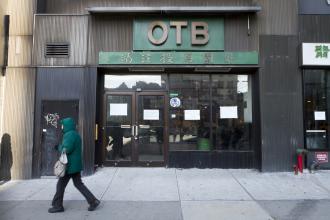
sign outside the once popular OTB parlor in Chatham Square in New York
City’s Chinatown remains untouched. NYCOTB closed Dec. 7, 2010.
The
moment I swore never to return to another offtrack betting parlor in
New York City was on the second Saturday of April 2010. I arrived at
noon to the tiny OTB in downtown Brooklyn. The parlor was in a squat
gray building on a dreary side street around the corner from Brooklyn’s
Municipal Building and courthouses, not far from historic and affluent
Brooklyn Heights. Its immediate neighbor was Empire Bail Bonds.
Inside was a diverse crowd, but alike in that few had much to bet.
Nobody seemed to be handicapping. Most didn’t even have programs. One
short, kinetic man bounced around the room rooting for every horse in a
race, yet somehow was never happy with the result; he watched the few
newcomers suspiciously, as if they were intruding on his social club. A
small group of Jamaican men held sway in one corner. Two older women did
a crossword puzzle in the back. At 2, a tattered old man finished off a
bottle of Colt 45 nestled in a brown bag, set it on the floor, swung
his legs around, and stretched his body across three seats and sank into
a deep slumber. I looked outside the dust-covered windows and saw the
first great sunshine of spring. I left hastily.
Eight months later, on Dec. 7, 2010, New York City Off-Track Betting
Corporation closed. The largest bookmaker in the country, dead at the
age of 40.
More than two years later, the impact of New York City OTB’s closing
is still felt acutely – most of all by former employees, but also by
bettors and anyone who came into its orbit during its outrageous
lifespan. Their stories reveal an era of New York City that no longer
exists, washed away by wealth and the chasm-like gap in it. They speak
to a cultural resonance, a grittiness once symbolic of New York that,
for all its mishaps, OTB had in spades. When people cared more about
horse racing and had a convenient place to share that interest with
others.
At the time of its demise, 54 parlors were left, down from more than
150 at its mid-1980s peak. There were also three floors of office space
in the old Paramount Pictures building at 1501 Broadway on Times Square.
About 1,300 employees lost their jobs, and 900 retirees were stripped
of their health insurance.
Mayor Ed Koch said point-blank in 1984: “OTB here in the city of New
York is civil service.” Employees were told on their first day that
working 25 years guaranteed them a pension and health insurance after
retirement. Benefits were paid out of OTB’s profits, but when those
profits became losses – something nobody anticipated when drafting its
legal framework in 1970 – the retirees were forced into the cold. They
have suffered dearly.
Michael Mellon, 58, was one of the longest-serving employees. He
managed a parlor in Coney Island for the final eight years of his
36-year career, which began as a part-time cashier at 18. He retired in
December 2008 and expected to enjoy retirement with his wife, who worked
at OTB for eight years, and his daughter, a recent college graduate and
aspiring stage actress.
Mellon didn’t anticipate losing his health insurance. But in the
spring of 2011, he received a letter from the city terminating his
benefits.
“It felt like a stab in the heart,” he said. “None of us when we were working all those years imagined this would happen.”
Mellon left Brooklyn College in 1972 to work as a part-time cashier.
He had aims of playing the guitar on the side, but in his mid-20s he
decided to stick it out at OTB. He liked the job, but like other city
employees his abiding motivation was the perpetual benefits. He was a
cashier for 17 years, night manager for seven, pool manager for three,
and finally a branch manager, which made him part of a select group of
employees.
Thinking about all he went through, Mellon spoke emotionally: “I felt
like they tried to invalidate my life.” His voice cracked, and he
paused to gather himself. “I stuck it out there because I knew I’d have
health benefits for my family and I.”
Mellon, who lives in Queens near Aqueduct Racetrack, now pays $1,500
per month for insurance for his wife and daughter. Some nights, he
dreams that he is called to work the night shift at one of his old
branches in Brooklyn’s far-flung Bensonhurt neighborhood. He did not
raise the white flag, however. Drumming support from elected officials
and his fellow retirees, many of whom were worse off, Mellon led a
grassroots campaign to restore their benefits in Albany. Twice Gov.
Andrew Cuomo vetoed a bill doing so, most recently in December. Mellon
refuses to quit and continues to meet with local politicians and pepper
fellow retirees with updates on their Facebook page.
When Mellon retired, Joseph Fusco, then 36, was on his way in. An
independent filmmaker and lifelong New Yorker, Fusco was looking for a
night job so he could edit his film during the day. He learned of the
job through a friend of his mother’s. He joined a sizable 400-person
phone betting operation on the 10th floor of 1501 Broadway.
Fusco was a per-diem employee, the first rung of three leading to
full-time status. He knew nothing about horse racing, but two weeks of
intensive training prepared him. Like a stevedore, he would call the
scheduling manager every day and request a shift. He rarely had trouble
getting one until OTB entered bankruptcy.
Fusco relished the experience. He joined a workforce in phone betting
that epitomized the diversity of New York in terms of race, age, and
ethnicity. There were octogenarians and twenty-somethings, people who
had worked there decades and rookies who were students or recent
graduates. He found other artists, students, and musicians, similarly
drawn to OTB for its flexibility.
“OTB was a fantastic place to work if you are interested in the human
condition, as I am,” he said with a laugh. “It was as much there for
the employees as well as the customers.
“When I started it really was the perfect scenario for me,” he
continued. “The job for me was fairly easy; I knew what was expected of
me. I sat down, I took bets, I left. There was no emotional baggage
attached to the job. The worst part really was fighting your way through
Times Square to get to the subway.”
Returning home, he would edit until eight in the morning, sleep, wake
up and edit some more, and go to work. He was close to becoming
full-time when, a week shy of his two-year anniversary, his manager told
him to forget coming in. It was swift and decisive.
OTB had been to the brink so many times before that, like the boy who
cried wolf, nobody thought it would actually close. There was no
farewell party, no good-byes, no chance to exchange phone numbers with
colleagues.
This angered Fusco, and he responded in the way he knew how. With
Matthew Flannery, co-producer and director of photography, he is making a
documentary on the subject entitled “Finish Line: The Rise and Demise
of Off-Track Betting.” He has started editing and is currently holding a
fund-raising campaign. Tragedy motivated him: two former colleagues and
friends he interviewed – Patti McCole and Barbara Sweeting – died from
health complications after losing their insurance.
Looking at the fate of its blue-collar employees, Fusco said he saw
an American story that reaches Wisconsin and other places where unions
have come under attack. It also reveals the changes in New York over the
last 30 years.
“OTB was the last bastion of the pre-gentrified New York City,” he
said. “Its loss takes away another place where poor and working-class
folks could go and hang out.”
OTB intended to provide revenue to localities and clean the streets
of organized-crime bookmaking. Little care was afforded to the
street-front parlors, or their patrons; they were designed spare and
greenish, shorn of amenities. Their trademark was convenience. They were
community centers of a sort, and almost admirable in their stubborn
seediness. This was New York after all, not Tucson.
Some parlors remain undisturbed. One of the most popular, on Chatham
Square in Chinatown, endures like a museum exhibit. The doors were
padlocked on a recent visit but otherwise everything remains the same
outside and inside, except with two years of dust collected. Chinese
letters hang below the OTB signage. Untouched are two walls of
Plexiglass-protected teller windows.
It was always crowded, and until the citywide ban you could barely
see through clouds of cigarette smoke. Before the races, Chinese men
used to sit at the counter of the greasy dim-sum restaurant next door,
examining the entries while eating Frisbee-sized pork buns. Flyers
notifying patrons where to cash their remaining tickets are still stuck
on the dirty windows. Standing there, you half expect somebody to walk
up and unlock the door, open the register and begin taking bets.
OTB still handled approximately $750 million a year upon its death –
nearly 40 percent of the state’s parimutuel handle. Of the total, about
$140 million was bet through its advance-deposit wagering operations. So
how did it lose money?
Simple, says Sandy Frucher, the former chairman who was appointed in
2009: All of its contractual obligations, to the city and state and the
racetracks, came off the top of revenue instead of profits. Then came
rent on their many parlors and millions in benefits to their employees
and retirees. Unfunded post-employment retirement benefits bulged its
deficit.
“The fundamental problem with OTB was not management or the running
of OTB,” said Frucher, now the vice chairman of the NASDAQ OMX Group.
“All of the payments required by the Legislature of OTB put our
distributions ahead of expenses.”
Frucher, who worked for free for OTB, quit after a year. He had
offered a plan that would have cut staff in half, closed most parlors,
and installed self-service kiosks in dozens of bars and restaurants.
Much of his plan, which ended up before the state Senate, would have
allowed the operation to downsize significantly but stay in business.
Frucher apparently had the best interests of employees in mind. At
the first DC-37 union rally after OTB closed, he told employees that he
wished he could have done more. He feels the employees were made
scapegoats and then victims.
“During the creation of OTB or the transition to the state,” he said,
“it was never fully disclosed to the employees or retirees what a shut
down would mean.” He called this “unethical and immoral.”
After Frucher left, Greg Rayburn, a corporate “turnaround expert,”
was hired on a $125,000 a month salary – 10 times more than his
predecessor. There was no turnaround. Rayburn soon took his talents to
Hostess Brands, which had strong unions like OTB. Three months ago, the
Twinkie died.
OTB couldn’t resurrect itself because it never had a real business
plan. The first chairman, Howard Samuels, staffed upper management with
people who would work on his campaign for governor while thousands of
applications from people with racetrack backgrounds went unopened,
according to Irving Rudd, the famous sports publicist who worked for OTB
in its early years.
So it grew haphazardly. In 1974, the state and city added a 5 percent
surcharge on all winning bets despite bitter opposition from OTB. It no
longer had to maximize its revenue but only increase handle to pay
localities from the increased surcharge. More branches were opened. Over
time OTB horse-traded with the racing industry for more signals, live
calls, the display of live odds.
Oversaturation became the norm. Simulcast theaters were opened in
restaurants, places like the Inside Track on the East Side, the Winner’s
Circle near Penn Station, and the Yankee Clipper across from South
Street Seaport. The Yankee Clipper was on the ground floor of a
beautiful old ship chandlery built in 1840, the only surviving granite
Greek Revival building in the city.
If OTB couldn’t make it there, then where could it?
Kevin Depew, 44, was a Clipper habitué during its final 3 1/2 years. A
native of Lexington, Ky., who bought his first house there using his
track winnings, Depew had moved to New York in 2004 with his family to
become the editor of a financial news website. Settling above the
legendary Paris Café on Peck Slip in 2005, he went looking for the
nearest OTB.
He bounced around to the Financial District, Tribeca, and Chinatown,
before one day realizing that the Yankee Clipper, only a few blocks
south, was more than a fancy looking restaurant. It was not clearly
marked; only white print on small blue awnings over each window revealed
its nature. The first awning read: NYC OTB. Yankee Clipper on the
second. Teletheatre. Restaurant. Then repeated. The clever advertising
was intentional, so tourists might wander in from the Seaport. The food
was lousy.
In the rear of the windowless restaurant was the bar, which is where
Depew commanded a booth most weekends. There were three tellers in the
place. There was also a basement room, with self-service machines, where
a familiar Asian-American crowd resided. They were serious bettors and
often had laptops out. There were also two high-roller rooms upstairs.
On an ordinary weekend, 60 people might show up.
It was a minor, but perhaps vital part of the residential community.
Depew said he and friends used to watch the Triple Crown at the Paris
Café, and they would draw straws to see who had to run bets to the
Clipper. Most people kept to themselves at the Clipper, which as a
serious horseplayer Depew appreciated. Like all OTBs, however, there was
one tragic figure who showed up regularly. He worked in the Financial
District and lived nearby.
“You would hate to see him,” Depew said, “because you know money is
being lost and lives ruined. He showed up most weekends. He’d say, ‘I’m
not here to gamble. I’m just here to have a beer. Going to pick up the
kids soon.’ Then you’d see him two hours later having gone to the ATM
twice and sitting at the bar with a load of tickets.”
It was a strange place, and as grim as any other OTB in its twilight
years, Depew said. “The only difference is, it looked good on the
outside.”
As OTB went, so did the Clipper. A new law in 2003 allowed OTB to
stay open later to show evening Thoroughbred racing. Thinking this
expansion would be a gold mine, OTB had to compensate harness tracks for
the supposed competition. Expenses and overtime pay skyrocketed, but
additional handle never materialized, leaving OTB locked into even more
expensive contracts. Its image was not helped by profligate spending: It
had a fleet of 87 cars, and employed 22 executives.
OTB was a sinking ship, but not only metaphorically. The parlors
became even more bare bones in a self-destructive cycle. In the final
months, the Clipper, with its lack of windows and nautical theme, grew
to resemble a sunken cruise ship. It took on water until it scared
everybody away. The restaurant had ceased to function, leaving only a
nearly empty bar. Depew remembers watching the Breeders’ Cup there one
month before it closed.
“They didn’t have soda guns anymore,” he recalled. “They had
two-liter bottles of Coke and 7-Up for making mixed drinks. I don’t
think they had beer on tap, only domestic bottles.”
Still, Depew remembered, “There was a sense everybody had that you
can’t close the OTBs. You can’t have New York City without the OTBs.”
The bets found their way into the pools, even though bettors
scattered. The New York Racing Association profited from the fallout.
They got OTB’s ADW operation for free; a majority of its 20,000 accounts
migrated to NYRA Rewards, which has seen that same number of accounts
added in two years. For months after OTB closed, NYRA bused bettors from
a dozen city parlors to Aqueduct. You get the sense that the tracks
were happy to see NYCOTB and its seedy parlors go.
In 2011, NYRA’s ontrack handle – which includes phone and Internet
wagering – rose $219 million, which works out to 36 percent of the $616
million wagered on Thoroughbreds at NYCOTB in its final 11 months and
one week. NYRA draws about four times as much revenue from each ontrack
bet as it did from one placed at OTB.
NYRA has proposed installing self-service terminals in existing bars
and restaurants, beginning with 10 and growing to 40 in five years – a
low-overhead model, short on staff. But its own instability since being
taken over by the state has put this plan on hold.
Something will replace OTB, but whatever does will look nothing like
it. Few people will protest one way or another. New York City is a
wrecking ball, but maybe the Landmarks Commission can offer historic
status to one parlor, like the one in Chinatown.


 Freeport photos
 Village halls across Long Island
 March 2013 village elections on LI




New York OTB: Remembering a city icon