This blog is not affiliated or endorsed, by Nassau OTB, a public benefit corporation, subject to the New York Freedom
of Information Law, NY Pub Off Law Sec 84 et seq.
and fo not forget that nassau otb employees seek athe public records of the ppp losn recrived by nassau otb from the dime and application for loan foregiveness with supporting records if sny
Stop scratching on holidays Published: June 1, 2012
Off Track Betting in New York State has been racing into a crisis called shrinking revenue. Some people have spitballed a solution: Don’t close on holidays. New York State Racing Law bars racing on Christmas, Easter and Palm Sunday, and the state has ruled OTBs can’t handle action on those days, even though they could easily broadcast races from out of state. “You should be able to bet whenever you want,” said Jackson Leeds, a Nassau OTB employee who makes an occasional bet. He added some irrefutable logic: “How is the business going to make money if you’re not open to take people’s bets?” Elias Tsekerides, president of the Federation of Hellenic Societies of Greater New York, said OTB is open on Greek Orthodox Easter and Palm Sunday. “I don’t want discrimination,” Tsekerides said. “They close for the Catholics, but open for the Greek Orthodox? It’s either open for all or not open.” OTB officials have said they lose millions by closing on Palm Sunday alone, with tracks such as Gulfstream, Santa Anita, Turf Paradise and Hawthorne running. One option: OTBs could just stay open and face the consequences. New York City OTB did just that back in 2003. The handle was about $1.5 million – and OTB was fined $5,000.
Stop scratching on holidays Published: June 1, 2012
Off Track Betting in New York State has been racing into a crisis called shrinking revenue. Some people have spitballed a solution: Don’t close on holidays. New York State Racing Law bars racing on Christmas, Easter and Palm Sunday, and the state has ruled OTBs can’t handle action on those days, even though they could easily broadcast races from out of state. “You should be able to bet whenever you want,” said Jackson Leeds, a Nassau OTB employee who makes an occasional bet. He added some irrefutable logic: “How is the business going to make money if you’re not open to take people’s bets?” Elias Tsekerides, president of the Federation of Hellenic Societies of Greater New York, said OTB is open on Greek Orthodox Easter and Palm Sunday. “I don’t want discrimination,” Tsekerides said. “They close for the Catholics, but open for the Greek Orthodox? It’s either open for all or not open.” OTB officials have said they lose millions by closing on Palm Sunday alone, with tracks such as Gulfstream, Santa Anita, Turf Paradise and Hawthorne running. One option: OTBs could just stay open and face the consequences. New York City OTB did just that back in 2003. The handle was about $1.5 million – and OTB was fined $5,000. Easy money.
Trump nominates Amy Coney Barrett to replace Ruth Bader Ginsburg on Supreme Court as Andrew Cuomo keeps the faithful out of Nassau OTB despite NY Const Ar 1 sec 3
President Trump has named Judge Amy Coney Barrett as his choice to replace late Associate Justice Ruth Bader Ginsburg on the Supreme Court — a long-sought victory for conservatives and the anti-abortion movement.
Trump, praising his nominee as “one of our nation’s most brilliant and gifted legal minds,” made her candidacy official in a Rose Garden ceremony Saturday.
“Amy Coney Barrett will decide cases based on the text of the Constitution as written,” he said. “As Amy has said, being a judge takes courage. You are not there to decide cases as you prefer but to do your duty and follow the law wherever it may take you.”
He also noted that Barrett will be the first mother with school-age children ever to serve as a Supreme Court justice.
“Thank you for sharing your incredible mom with our country,” he told the seven Barrett children, who sat in the crowd with their father and First Lady Melania Trump.
Barrett followed the president with a brief acceptance speech.
“I love the United States, and I love the United States Constitution,” she declared.
She praised her predecessor, the late Justice Ruth Bader Ginsburg, as a woman who “not only broke glass ceilings, she smashed them. For that she has won the admiration of women across the country and indeed all over the world.”
Barrett’s nomination seals one of the most ambitious promises of Trump’s 2016 presidential campaign: the conservative transformation of the federal judiciary. If she is confirmed, the court would lean to the right, six justices to three, for years to come.
The 48-year-old mother of seven would be the Court’s youngest justice by five years. The lifetime appointment could mean a decades-long tenure that would remake American jurisprudence for a generation.
Barrett, a first-in-her-class graduate of Notre Dame Law School, would also be the only non-Ivy Leaguer on the nation’s highest court — a subtle nod to Trump’s populist base.
18
President Donald Trump with SCOTUS nominee Judge Amy Coney Barrett at the White House today.
Getty Images
The choice cements Trump’s bond with the religious right, a key Republican constituency, just five weeks before Election Day.
Conservative Christians have claimed Barrett as a heroine since 2017, when Trump nominated her to a seat on the Chicago-based 7th Circuit Court of Appeals.
At her confirmation hearing, Sen. Diane Feinstein (D-Calif.) grilled Barrett on her Catholic faith. “The conclusion one draws is that the dogma lives loudly within you, and that’s of concern,” Feinstein said — a comment that, to Republicans, smacked of an unconstitutional religious test for the office.
“Barrett is the ultimate deliverable for the pro-life movement,” George Washington University law professor Jonathan Turley told The Post. “For conservatives, Barrett is the trifecta with the two prior Trump nominees,” Associate Justices Neil Gorsuch and Brett Kavanaugh.
She is seen as a judge in the originalist mold of Justice Antonin Scalia, for whom she served as a clerk before launching a celebrated career in academia. In her remarks Saturday, Barrett confirmed that expectation.
“His judicial philosophy is mine too: judges must apply the law as written,” she said. “Judges are not policy makers, and they must be resolute in setting aside any policy views they might hold.”
Barrett became a professor of law at Notre Dame and a noted legal scholar of statutory and constitutional interpretation, known for incisive papers arguing that the meaning of any law must remain tethered to its history and its framers’ original intent.
But with only three years on the bench, Barrett’s judicial record is limited. She has forcefully endorsed a Second Amendment guarantee of an individual right to own guns, and wrote a scathing decision defending male students’ rights to due process in campus sex-assault tribunals.
She has also applied a by-the-book interpretation of immigration law — including a case siding with the Trump administration’s effort to restrict welfare benefits for non-citizens.
While Barrett on Monday was endorsed by the Susan B. Anthony List, a top anti-abortion advocacy group, she has been careful not to condemn Roe v. Wade, the landmark 1973 decision that made abortion a constitutional right.
Enlarge ImageAmy Coney Barrett during her investiture as judge for the US Court of Appeals for the Seventh Circuit at Notre Dame Law School in February 2018.EPA
“She clearly testified that she will set aside her personal beliefs and follow the law,” said Mike Davis, president of the conservative Article III Project. “And her three years on the 7th circuit have made crystal clear that that is what she has done.”
But in scholarly papers, Barrett has explored the idea that past Supreme Court cases may be overturned, despite the precedents they have set, if the cases were “wrongly decided.” One such case, she noted, was Planned Parenthood v. Casey (1992), an important abortion decision that upheld and modified Roe.
An outright overturn of Roe will likely remain a bridge too far, even for a Supreme Court dominated by conservatives, experts say.
“I don’t think the conservative justices have the stomachs or the intellectual inclination for such a radical move,” said prominent First Amendment attorney Ron Coleman. “What I do think, however, is that they’ll begin the process of trimming back what has become an absolutist, unconditional right to abortion under all circumstances.”
Senate Majority Leader Mitch McConnell has made it a personal crusade to confirm as many Trump-nominated federal judges as possible, to the Democrats’ chagrin.
Enlarge ImageJudge Amy Coney Barrett with her husband Jesse.Julian Velasco
The Senate has installed 218 of Trump’s nominees in federal court seats — more than any first-term president since 1980, and more that a quarter of all active judges on the bench.
The fast-track plan to confirm Barrett ahead of the Nov. 3 election comes despite opposition by two GOP senators, Lisa Murkowski of Alaska and Susan Collins of Maine, but no one else has broken ranks.
A Judiciary Committee hearing on the nomination could begin as soon as Oct. 12, and a confirmation vote in the Senate — where Republicans have a 53-47 majority — could be held Oct. 29.
Democrats have been crying foul because Senate Majority Leader Mitch McConnell (R-Kentucky) refused to let lawmakers consider then-President Barack Obama’s SCOTUS nomination of District of Columbia Circuit Court Judge Merrick Garland following the death of death of Supreme Court Justice Antonin Scalia in February 2016, on grounds it was an election year.
But the Dems have few tools to derail McConnell’s plan to immediately fill Ginsburg’s seat. With a 53-seat Senate majority and almost all of his caucus in lockstep behind him, McConnell has no incentive to wait.
“There’s no question about the right to do it,” said Coleman. “I worry about the threat to the integrity of the Constitutional process posed by the cynical campaign to convince the public otherwise.”
But the political fallout could be widespread — and unpredictable.
A third of the Senate is up for re-election in just 38 days, including eight members of the Senate Judiciary Committee. Contentious confirmation hearings could help vulnerable Republican Sens. Joni Ernst (R-Iowa) and Thom Tillis (R-N.C.) burnish their records — or could drive opposition turnout in their closely divided states.
None of the three Judiciary Committee Democrats up for re-election are at any risk of losing. But those with showboat tendencies, like Sen. Cory Booker (D-N.J.), will undoubtedly make the most of the spotlight.
Meanwhile, the hearings will provide an unexpected stage for the Democrats’ vice presidential nominee, who is also a Judiciary Committee member.
“Mitch McConnell is giving Kamala Harris free airtime to rally the base,” said a Democratic Senate insider. “You are just giving the veep nominee a platform to roast a conservative justice.”
But if Harris appears to attack the nominee based on her religious convictions — even as her running mate, Joe Biden, woos Catholic voters in Florida and the Rust Belt — the opportunity could backfire.
“If Democrats want to pursue their unconstitutional religious test and anti-Catholic bigotry, it will turn out very badly for them on November 3,” Davis said.
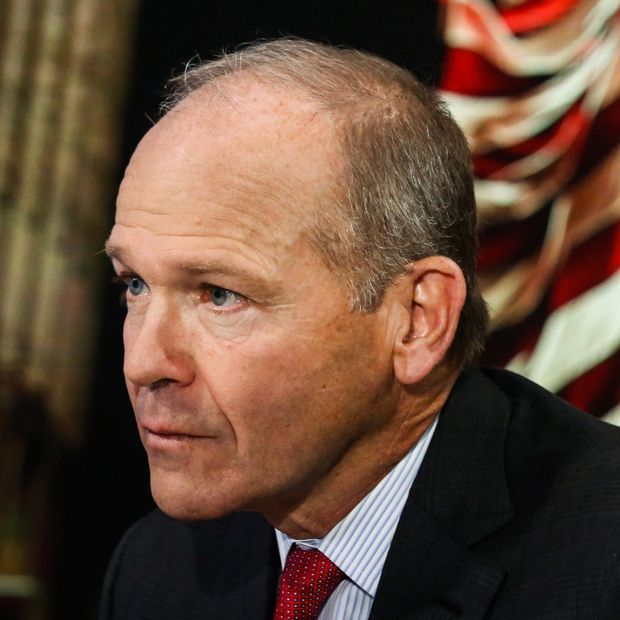
Chief Executive Officer Dennis Muilenburg had been assuring directors for months that regulators would soon clear the grounded jet to fly again, but his predictions hadn’t panned out.
It wasn’t just because Mr. Muilenburg’s forecasts had proven unreliable. Board members concluded that he had become part of the problem by mismanaging Boeing’s relationship with the Federal Aviation Administration, the one agency the company had to win over to emerge from its nearly yearlong crisis, people familiar with the matter said.
His departure followed a disastrous week that included a botched spacecraft launch, but replacing him had been under consideration for weeks as board members heard from frustrated officials at airlines losing hundreds of millions of dollars from their parked MAX fleets, these people said.
Despite the mounting problems, Boeing’s board stuck by Mr. Muilenburg nearly all of last year, even expressing full confidence in him as CEO while taking away his chairmanship in the fall. They believed they had the right leader to fix the MAX—until they abruptly reversed course two months later.
Many aviation industry officials had expected Boeing’s board to keep Mr. Muilenburg in place at least until the FAA approved the MAX to fly again. But the timetable kept slipping. For months, Mr. Muilenburg’s projections appeared to preserve the board’s support. Eventually, though, the board grew alarmed that the job wasn’t getting done—and that he had upset the FAA in the process.
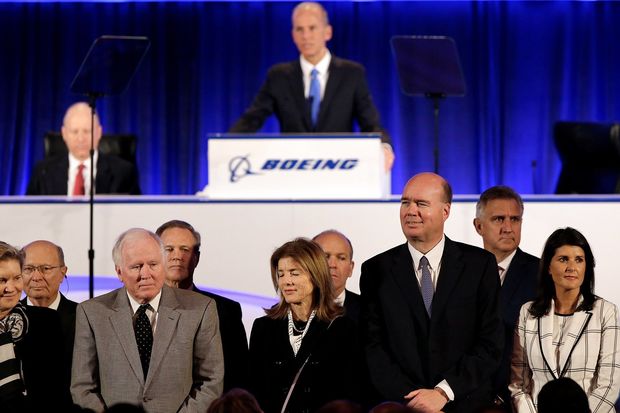
Mr. Muilenburg introduced Boeing's board of directors at a shareholder meeting last April. From left: Susan Schwab, Admiral Edmund Giambastiani Jr., Edward Liddy, Arthur Collins Jr. (behind Liddy), Caroline Kennedy, Dave Calhoun (behind Kennedy), Larry Kellner, Robert Bradway and Nikki Haley.
PHOTO: REUTERS
Director Larry Kellner , the former Continental Airlines CEO who became Boeing chairman in the shake-up, was one of the first to lose confidence in Mr. Muilenburg, according to the people familiar with the matter. Mr. Kellner had been hearing from airline officials frustrated about the prolonged grounding, giving him a direct view of the damage being done.
Plans accelerated once Steve Dickson , the FAA chief, rebuked the CEO on Dec. 12 and said that same week the MAX wouldn’t return to service until the new year, according to the people familiar with the matter. While Mr. Muilenburg viewed the meeting with Mr. Dickson as constructive, the board’s dimmer assessment further undermined the optimism the CEO had projected and his credibility, a person close to the board said.
On Dec. 22, directors held a 90-minute conference call without him, according to the person close to the board. After they finished, Mr. Kellner and fellow board member Dave Calhoun called Mr. Muilenburg and told him he was out. Mr. Calhoun, who once ran General Electric Co. ’s airplane-engine business, is expected to start as the new CEO next Monday.
Federal Aviation Administration chief Stephen Dickson rebuked Mr. Muilenburg in December.
PHOTO: ERIK S. LESSER/EPA/SHUTTERSTOCK
Mr. Muilenburg hadn’t been aware he had lost the board’s confidence until that phone call, people familiar with the matter said. He resigned, effective immediately.
“His greatest strength was his optimism, and his greatest weakness was his optimism,” said a friend who has spoken to him recently.
In an interview days before his ouster, Mr. Muilenburg defended his estimates for returning the MAX to service and stressed regulators ultimately would determine the timeline. After his departure, Boeing said its board decided a leadership change was necessary to restore confidence as the company works to repair relationships with regulators and customers.
Mr. Calhoun had become more engaged in managing the company after the board stripped Mr. Muilenburg of his chairmanship on Oct. 11 and gave it to Mr. Calhoun. Mr. Calhoun, a private-equity executive who had been an executive at GE for years, was viewed as the board member with the most relevant aviation and manufacturing experience.
Board members discussed with Mr. Muilenburg the possible scenario of replacing him as CEO, one of the people familiar with the matter said.
The most surprising aspect of the October announcement, said consultant Kevin Hiatt, a former safety chief at JetBlue Airways Corp., is that Mr. Muilenburg “could have been completely released” but wasn’t.
Related Video
Boeing vs. Airbus: The Aviation Industry’s Swinging Power Balance
YOU MAY ALSO LIKE
UP NEXT
0:00 / 6:22
Boeing vs. Airbus: The Aviation Industry’s Swinging Power Balance
As Airbus is set to overtake Boeing to become the world’s largest plane maker by deliveries, WSJ explains how two jetliners—the 737 MAX and the A320neo—ended up at the center of the biggest rivalry in the aviation world. Photo illustration: Jaden Urbi
The airline’s effort to get the MAX back into the air hadn’t been going well. The jet had been grounded for half a year. Projections for regulatory approvals to resume flying had slipped and slipped again. American Airlines Group Inc. said it would pull the MAX from its flight schedules until January, the latest in a string of disruptive schedule changes for airlines.
Top officials at the European Union Aviation Safety Agency, the FAA’s counterpart, started saying they would need more time to complete their own review of fixes to the MAX flight-control system implicated in the crashes in Indonesia and Ethiopia—almost certainly pushing the jetliner’s return to 2020.
Mr. Muilenburg’s projection that the MAX would return to service early in the fourth quarter of 2019 slid. Boeing conceded that an FAA order to end the grounding might not come until November or even December.
Then came a barrage of bad headlines in October. A Boeing engineer’s whisteblower complaint alleged the company prioritized profit over safety. Aformer senior MAX pilot’s chat messages suggested the pilot had unintentionally lied to regulators. Then came Mr. Muilenburg’s late October testimony on Capitol Hill, during which lawmakers pressed him on why he hadn’t quit or offered to give up his pay given the 346-victim death toll from the dual crashes. “I am accountable,” he said.
Dave Calhoun, who once ran GE’s airplane-engine business, is expected to start as Boeing’s new CEO next Monday.
PHOTO: CHRISTOPHER GOODNEY/BLOOMBERG NEWS
Mr. Calhoun backed the embattled CEO during a Nov. 5 television interview on CNBC. He said Mr. Muilenburg had called him to offer to give up much of his compensation, which the board accepted. He praised the CEO’s work to add safeguards to the MAX, saying Mr. Muilenburg “has set us up for a return to service.”
SHARE YOUR THOUGHTS
Did the Boeing board act quickly enough in replacing the CEO? Join the discussion below.
The chairman declined to speculate in the interview how long Mr. Muilenburg might last as CEO, saying he had the board’s confidence to date. “If he can get us from here to the endpoint—and the endpoint being a MAX that’s flying in service and accepted by the flying public and begins to restore our brand—I might argue, he’s just about the most qualified executive in the world to be running a company like Boeing,” he said.
Soon after, hopes for winning FAA approval in 2019 dimmed significantly. It became apparent that tests to determine how to train pilots on the updated MAX would take more time than expected and would include a public comment period before regulators approved new training.
In early November, Boeing said it expected the FAA certification in December with training approvals to follow in January. Allowing Boeing to deliver aircraft before the agency approved related pilot training would relieve pressure on the manufacturer, which was running out of places to park its roughly 400 finished aircraft.
Mr. Dickson, the FAA chief, insisted his agency was in charge of the timeline, telling his staff to take as much time as needed to make sure the MAX is safe. “I am committed to backing you all up on this,” Mr. Dickson wrote in a Nov. 14 internal memo.
On Dec. 11, Mr. Dickson said in a television interview the MAX wouldn’t return to service in 2019, and the next day, he summoned Mr. Muilenburg to his Washington, D.C., office to chide the CEO for the perceived pressure. His unusual rebuke became public after the FAA sent written updates to lawmakers.
Mr. Dickson told Mr. Muilenburg that Boeing should focus on the “quality and timeliness of data submittals for FAA review,” and he took issue with what he saw as the company’s unrealistic schedule for returning the MAX to service, according to the updates to lawmakers.
For Boeing’s directors, the difficulties with FAA were a significant setback, the person close to the board said. Boeing couldn’t move forward on anything without the FAA’s certification, which was essential to resume MAX deliveries, allow airlines to pay Boeing for the planes and ease the manufacturer’s cash crunch.
With the FAA certification now seeming unlikely before February, Mr. Muilenburg told the board during a regularly scheduled Dec. 15-16 meeting that Boeing had little choice but to pause MAX production.
“It was a tough decision, but it’s not one where we arrive at that decision overnight,” Mr. Muilenburg said in an interview on Dec. 17, shortly after the board decided to halt production.
Boeing 737 MAX airplanes parked on Boeing property in Seattle.
PHOTO: DAVID RYDER/GETTY IMAGES
The suspension’s duration—and Boeing’s financial, production and overall business planning—depend on when regulators will allow the aircraft back in the skies.
Board members initially believed that removing Mr. Muilenburg before Boeing could lay the groundwork for the production halt would be potentially destabilizing for the company, the person close to the board said.
Later that week, United Airlines Holdings Inc., a major U.S. MAX buyer, announced it would extend the aircraft’s removal from its schedule through early June. The grounding was dragging on much longer than industry officials had envisioned.
Early on Sunday, Dec. 22, a Boeing spokesman told the Journal that Mr. Calhoun stood by his earlier endorsement of the CEO. Privately, though, Messers. Kellner and Calhoun had been speaking to fellow board members in the days before that weekend, leading to a unanimous decision to remove Mr. Muilenburg before the MAX returned to service.
“Dennis was surprised,” Mr. Muilenburg’s friend said. “They’re always with you until they’re not.”
—Andy Pasztor and Alison Sider contributed to this article.